> @DylanoA4 - [https://x.com/DylanoA4/status/2099552058311352719](https://x.com/DylanoA4/status/2099552058311352719) @DylanoA4 Wordcel 101: you can win arguments by using big words as a facade for understanding
Artificial Complexity
Everything Is Easy

I worry we're now going to get a dozen kinda fake new AI safety evaluation orgs that have no idea what they're doing

People ask why we can’t reform the education system. But right now students’ incentive is to go to the most prestigious college they can get into so employers will hire them – whether or not they learn anything. Employers’ incentive is to get students from the most prestigious college they can so that they can defend their decision to their boss if it goes wrong – whether or not the college provides value added. And colleges’ incentive is to do whatever it takes to get more prestige, as measured in US News and World Report rankings – whether or not it helps students. Does this lead to huge waste and poor education? Yes. Could the Education God notice this and make some Education Decrees that lead to a vastly more efficient system? Easily! But since there’s no Education God everybody is just going to follow their own incentives, which are only partly correlated with education or efficiency.
can someone at Spotify explain to me what in the hell they are doing with 45 hundred production deploys a day the website that doesn’t change at all until once a year they give you some basic ass crappy data about the songs you listened to??? > Boris sat down with Spotify VP of Engineering Niklas Gustavsson. > > Spotify ships 4,500 production deploys a day, and 73% of PRs are now AI-assisted. https://t.co/Bc0xPduumG > @ClaudeDevs - [https://x.com/ClaudeDevs/status/2071671418245492926](https://x.com/ClaudeDevs/status/2071671418245492926)
Critical Path by Buckminster Fuller This overall and inexorable trending to do more with less is known sum totally as “progressive ephemeralization.” Ephemeralization trends toward an ultimate doing of everything with nothing at all, which is a trend of the omniweighable physical to be mastered by the omniweightless metaphysics of intellect
I think a lot (too much) about a breakfast scene in Phantom Thread. The one where Daniel Day-Lewis’ character (the fabulously named Reynolds Woodcock), dress-maker extraordinaire (fully committed, utterly committed, consumed by dresses), is drawing, sketching, working on some design in silence while having breakfast with his new “muse” / lover, Alma. She butters the bread loudly. She pours her tea loudly. “Please, don’t move so much Alma,” he says. She looks at him like he’s nuts (he is a little nuts). “I’m buttering my toast. I’m not moving too much.” And he goes: “It’s hard to ignore, it’s as if you just rode a horse across the room.” He finally gets up and leaves. “Too much movement. Entirely too much movement at breakfast,” he says. Her movement has ruined the morning. I empathize with Reynolds probably more than I should. (While also feeling bad for Alma.) (Reynolds’ sister looks on in amusement; may we all rise to the level of sister.) On working days, when I’m trying to live entirely in Bookworld, that’s how I feel when I have to call, say, my bank. Too much movement. Entirely too much movement. Calling the bank. Listening to the touchpad menu options. Going through all the details with the bank person. Too much movement.
This a cousin of David Graeber’s conception of “bullshit jobs” He saw “flunkies” (people who exist to make someone else feel important), “duct tapers” (people who fix problems that shouldn’t exist), and “box tickers” (people who create the appearance that something useful is happening). he framed these as a systemic feature of financialized capitalism, managerial feudalism, and bureaucratic expansion. The system generates these roles, and people fill them.
“Never ask a barber if you need a haircut”
Sophisticated minds adopt simplified lifestyles; simplistic minds are drawn to overly sophisticated lifestyles.
book that should have been an essay
the myth of difficulty
Everything is easy.
To fight artificial complexity, you have to internalize that everything is easy.
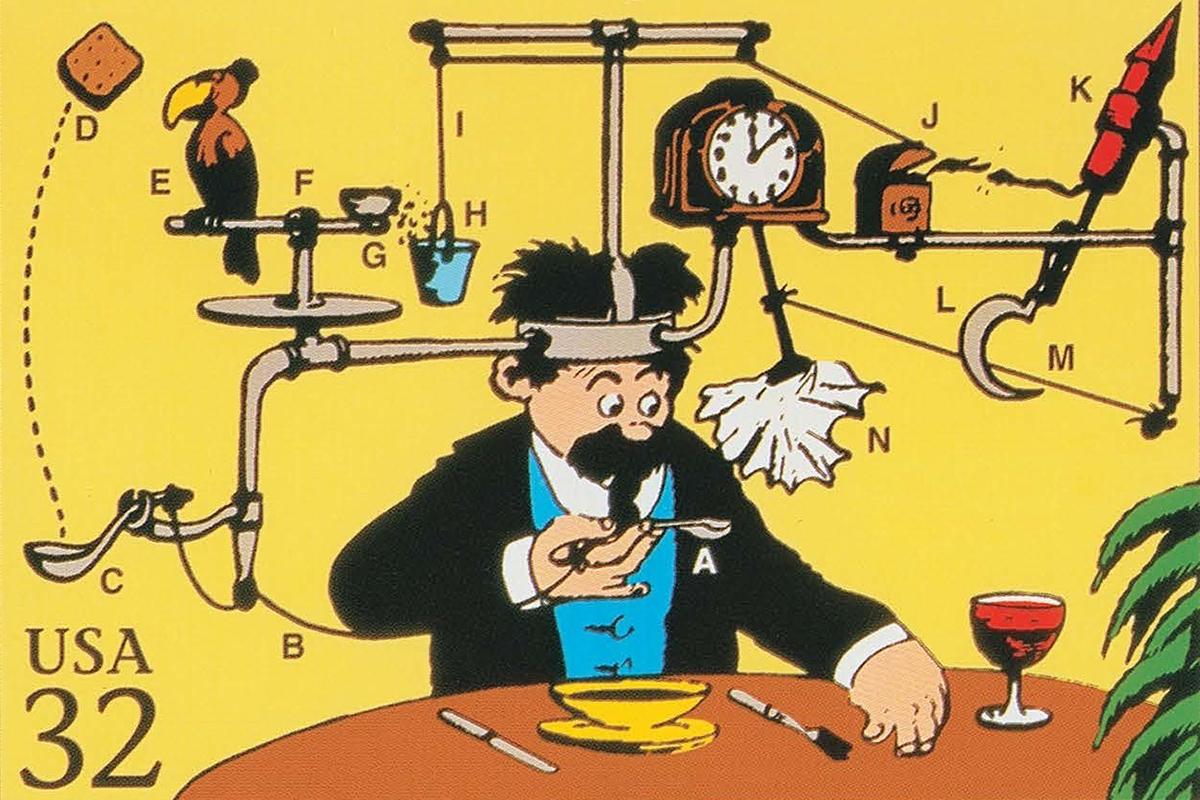
Artificial complexity is the art of making simple things hard, so that someone can sell you the solution.
What is artificial complexity? Offering a simple solution is not always in the best interest of a problem solver. If problems would be so easy there won’t be a market for all those savior ‘problem solvers’. There is some kind of incentive to make a problem a bit more complex. Just add that tiny bit of complexity to the recipe so you can sell it as some big magical thing. This misalignment in incentives has a major problem. The world gets crowded with complex solutions to simple problems.
Bureaucracies keep eating the freed workforce "Bureaucracy expands to meet the needs of the expanding bureaucracy" --Oscar Wilde
The Gordian Knot Never pay for complexity of presentation when all you need is results. Alexander the Megalos was once called to solve the following in the Phrygian city of Gordium (as usual with Greek stories, in modern day Turkey). When he entered Gordium, he found an old wagon, its yoke tied with a multitude of knots, all so tightly entangled that it was impossible to figure out how they were fastened. An oracle had declared that he who would untie the knot would rule all of what was then called “Asia”, that is Asia minor, the Levant, and the Middle East. After wrestling with the knot, the Megalos drew back from the lump of gnarled ropes, then made a proclamation that it didn’t matter for the prophecy how the tangle was to be unraveled. He then drew his sword and, with a single stroke, cut the knot in half. No “successful” academic would ever follow such policy. And no Intellectual Yet Idiot: for instance it took medicine a long time to realize that, when a patient shows up with a headache, it much better to give him aspirin or recommend a good night sleep than do brain surgery, although the latter appears to be more “scientific”.
It took medicine a long time to realize that when a patient shows up with a headache, it is much better to give him aspirin or recommend a good night’s sleep than do brain surgery, although the latter appears to be more “scientific.” But most “consultants” and others paid by the hour are not there yet.